
Vygotsky’s Sociocultural Theory of Cognitive Development
The work of Lev Vygotsky (1934) has become the foundation of much research and theory in cognitive development over the past several decades, particularly what has become known as sociocultural theory.

Vygotsky’s sociocultural theory
He views human development as a socially mediated process in which children acquire their cultural values, beliefs, and problem-solving strategies through collaborative dialogues with more knowledgeable members of society. Vygotsky’s theory comprises cultural-specific tools, private speech, and the Zone of Proximal Development.
Vygotsky’s theories stress the fundamental role of social interaction in the development of cognition (Vygotsky, 1978), as he believed strongly that community plays a central role in the process of “making meaning.”
Unlike Piaget’s notion that children’s development must precede their learning, Vygotsky argued that “learning is a necessary and universal aspect of the process of developing culturally organized, specifically human psychological function” (1978, p. 90). In other words, social learning tends to precede (i.e., come before) development.
Vygotsky has developed a sociocultural approach to cognitive development. He developed his theories at around the same time as Jean Piaget was starting to develop his ideas (the 1920s and 30’s), but he died at the age of 38. Hence, his theories are incomplete – although some of his writings are still being translated from Russian.
Like Piaget, Vygotsky could be described as a constructivist in that he was interested in knowledge acquisition as a cumulative event – with new experiences and understandings incorporated into existing cognitive frameworks. However, while Piaget’s theory is structural (arguing that physiological stages govern development), Vygotsky denies the existence of any guiding framework independent of culture and context.
Vygotsky’s Ideas
- Vygotsky’s theory focuses on the role of culture in developing mental abilities, e.g., speech and reasoning in children.
- According to Vygotsky, adults in society foster children’s cognitive development by engaging them in challenging and meaningful activities.
- Adults convey to children how their culture interprets and responds to the world. They show the meaning they attach to objects, events, and experiences. They provide the child with what to think (the knowledge) and how to think (the processes, the tools to think with).
- The interactions with others significantly increase the quantity of information and the number of skills a child develops and affect the development of higher-order mental functions such as formal reasoning. Vygotsky argued that higher mental abilities could only develop through interaction with more advanced others.
- Vygotsky proposed that children are born with elementary mental abilities such as memory and perception and that higher mental functions develop from these through the influence of social interactions.
- Vygotsky agreed with Piaget that the development of cognitive abilities takes place in stages. He also agreed broadly with the description of the stages; however, he viewed cognitive development as a social process where children learn from experienced adults.
- Vygotsky stated that language has two functions. Inner speech is used for mental reasoning, and external speech is used to converse with others. These operations occur separately. Indeed, before age two, a child employs words socially; they possess no internal language. Once thought and language merge, however, the social language is internalized and assists the child with their reasoning. Thus, the social environment is ingrained within the child’s learning.
Vygotsky’s theory differs from that of Piaget in several important ways:
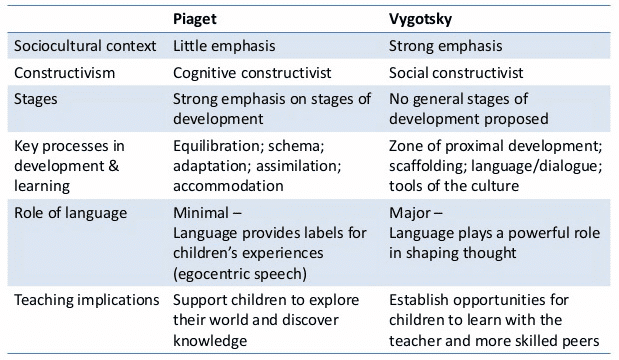
This contradicts Piaget’s view of universal stages and development content (Vygotsky does not refer to stages in the way that Piaget does).
Hence Vygotsky assumes cognitive development varies across cultures, whereas Piaget states cognitive development is primarily universal across cultures.
Vygotsky states the importance of cultural and social context for learning. Cognitive development stems from social interactions and guided learning within the zone of proximal development as children and their partners co-construct knowledge. In contrast, Piaget maintains that cognitive development stems mainly from independent explorations in which children construct knowledge of their own.
For Vygotsky, the environment in which children grow up will influence how they think and what they think about.
According to Piaget, language depends on thought for its development (i.e., thought comes before language). For Vygotsky, thought and language are initially separate systems from the beginning of life, merging at around three years of age, producing verbal thought (inner speech).
For Vygotsky, cognitive development results from an internalization of language.
Adults transmit their culture’s tools of intellectual adaptation that children internalize. In contrast, Piaget emphasizes the importance of peers, as peer interaction promotes social perspective-taking.
Higher Mental Functions
Eventually, through interaction within the sociocultural environment, these are developed into more sophisticated and effective mental processes, which Vygotsky refers to as ‘higher mental functions.’
Each culture provides its children with tools for intellectual adaptation that allow them to use basic mental functions more effectively/adaptively.
Tools of intellectual adaptation is Vygotsky’s term for methods of thinking and problem-solving strategies that children internalize through social interactions with the more knowledgeable members of society.
For instance, biological factors limit young children’s memory. However, culture determines the type of memory strategy we develop. For instance, in Western culture, children learn note-taking to aid memory. Still, in pre-literate societies, other strategies must be developed, such as tying knots in a string to remember, carrying pebbles, or repeating ancestors’ names until large numbers can be repeated.
Therefore, according to Vygotsky, cognitive processes—even those that take place on their own—are socio-culturally determined by the beliefs, values, and intellectual adaptation tools of the culture in which a person grows up. Thus, the tools of intellectual transformation vary from culture to culture – as in the memory example.
Social Influences on Cognitive Development

Like Piaget, Vygotsky believes that young children are curious and actively involved in their own learning and the discovery and development of new understanding. However, Vygotsky emphasized social contributions to the development process, whereas Piaget emphasized self-initiated discovery.
Vygotsky identified something he called a Zone of Proximal Development. This is a time when a good teacher is most crucial to the child. (The teacher does not have to be an adult. Peers can also serve as teachers.) This zone occurs when a child has not yet attained a skill and can’t reach it independently. However, when the child receives encouragement and guidance from the teacher, he can master the skill.
This encouragement and guidance is known as Scaffolding. Just as Scaffolding supports a painter in painting a building, the teacher supports the learner as he works toward his goal of a new skill. Once the painter completes his work and achieves his goal, the Scaffolding is removed. The same is true for the teacher and child. Once the plan is reached, the teacher is no longer needed and can step back.
Here is an article from Penn State Extension to help explain Scaffolding. Please download this for your files.
Need more information? Watch this video to gain a better understanding of Vygotsky’s work.

What does this mean to me?
Great Question!
Once you realize how important you are as a teacher, you begin to gain more confidence, and you will be able to work with the children, not for the children. You will look at your classroom a bit differently, thinking of ways to provide an environment to promote success by observing the skills children have acquired and recognizing the next steps needed to move on to new skills.
You will begin to create a language-rich environment for children because you know it contributes to their cognitive and social development. Now you know that when you ask children open-ended questions, children think about the world around them and begin toving to the next steps in their learning. “Ah Ha,” moments will begin to happen sometimes in the most straightforward ways, like learning if you label the shelves in your room to identify where objects belong. You will not only be providing support to help your children gain independence but also contribute to a language-rich environment.
Remember: Appreciating and acknowledging cultural differences creates an environment that optimizes learning and an inclusive environment for all children and their families.
Click the “Mark Complete” button to move onto Maria Montessori’s planes of development.