Prevent and Reduce Stress Throughout the Day
The following suggestions are appropriate for infants, toddlers and preschoolers.
- Offer plenty of opportunities for children to move their bodies-indoors and outdoors.
- Encourage kicking of legs and waving of arms, bouncing, pushing and pulling, cruising, walking, climbing, running, jumping, dancing, doing yoga poses, riding tricycles, and pulling wagons so children can expend energy and release endorphins, which often leads to happy feelings.
- Plan individual and group options for doing an activity. For example, use baby baths or dishwashing tubs for individual water and sand play. Offer the same kinds of props found in the group sand and water tables. Some children are not ready to share props and work alongside others at the group tables.
- Limit the time children have to wait. Have an infant’s bottle ready before he wakes up-you know how long he typically sleeps so you can do this. Plan for trips to the bathroom or hand washing sink so standing in line doesn’t lead to frustrated outbursts. Sing songs, do fingerplays, retell or add to stories, or play games when a short wait is unavoidable.
- Reduce the buzz and glare from overhead lights. Turning off a few overhead lights often has a calming effect on children. If it seems too dark, turn on a lamp or two.
- Spend one-on-one time with each child. Read a book, talk during routines and transitions, and comment on a child’s activities. In short, focus complete attention on a child-even if just for a few minutes as many times a day as possible.
- Establish routines and rituals. Individualize rituals to reflect what children do at home so that they begin to regulate and organize their own behavior. For example, sing the same song (in the same language) at the start of nap time or rub toddlers’ backs to lull them to sleep.
- Have some fun. Make funny faces and noises, read a humorous book, act it out with puppets, create and wear silly hats, and invite children to laugh. Create an atmosphere where children enjoy being part of a caring, joyful community.
Involve Families So Children Feel Connected to Their Loved Ones
The following suggestions are appropriate for infants, toddlers, and preschoolers
- Communicate with families daily. Parents of young infants tend to be particularly interested in eating, sleeping, and diapering-they want to know details from when their baby was in your care and want to tell you about how they care for their baby at home. For families of older children, exchange news (in person or in a text, note, or e-mail) about what excites, upsets, and interests a child. Include photos if possible. Share what the child does and plays with at home and at the program. Use this information in conversations with children and to adjust the environment, interactions, and activities if needed.
- Help families devise a unique ritual for drop-off and pick-up times. This can make these transitions less stressful for all. For example, perhaps Wiley’s dad lets her gently push him out the door when she is ready for him to leave. This sense of control.
- Reflect families and their home languages and cultures in the setting. Post family photos and posters (include all family members on these) on the wall and in scrapbooks; invite family members to critique the environment, interactions, and use of their home language so you can be sure you are offering a culturally appropriate program.
- Encourage families to visit during the day, if they are available. Greet the visitors warmly; invite them to eat lunch with their children; ask visiting family members to read with a small group; help a child find her lost shoe, or share a talent or interest with the children.
- Make and show brief slide shows or videos of daily life at the program. You can upload them to a computer or tablet and have them playing in a continuous loop at drop-off and pick-up times.
Set a Few Simple Rules that Match Children’s Development and
Keep Them Safe Start with a few rules
Very young children are just beginning to develop the capacity to remember. Start with just four or five essential rules that keep everyone physically and emotionally safe, like the following:
- Walk inside; run outside.
- Talk in regular voices inside; use loud voices outside.
- Be kind.
- Put away the things you play with materials.
- Take care of our play materials
These few rules may be enough to maintain a positive learning community. If you do add additional rules, review them periodically to make sure they are really necessary. The following strategies can help you set and maintain a few rules.
Involve toddlers and preschoolers in establishing rules. Children are most invested in rules that they have suggested and discussed. They will be motivated to remember the rules and to remind others.
Communicate rules and reminders by stating what to do. Young children understand and remember positive wording more readily than being told what not to do. If the rule’s intent is for children not to do something, you can still state the rule positively. For example, “Use blocks for building.” “Walk inside.” “Use your words.”
Gently remind children of rules when they forget. “Conor, I think you left some toys on the table. Please put them away before getting ready for outdoor time.”
Explain why a rule is needed. For example, young children are starting to understand cause and effect. They can predict that if they run indoors, they might knock down and hurt another child or trip and hurt themselves. Therefore, children can understand why they should walk inside.
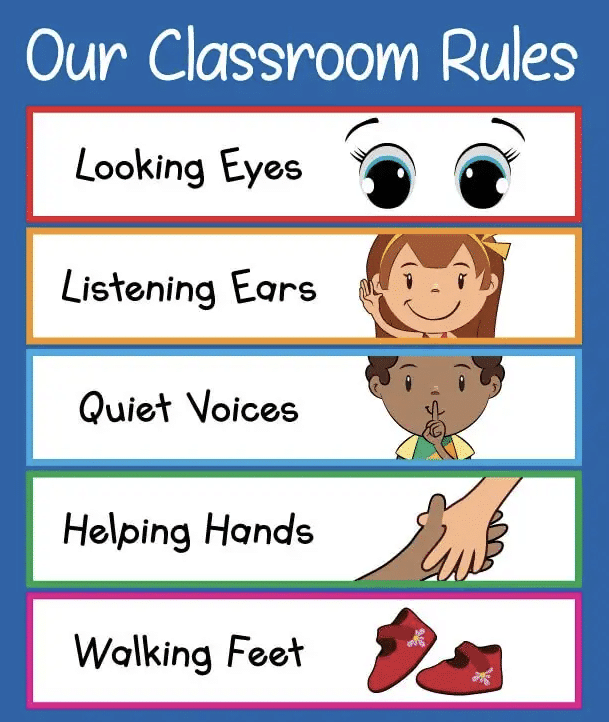
Display setting rules in all the children’s home languages, accompanied with photos or illustrations. Post the rules and review them as needed. Most children in your setting are still learning to read, so it’s helpful to post the rules with pictures. Take photos of children following the rules, and use them to prompt discussions and reminders.
Work with colleagues to apply rules consistently. Young children work hard to remember and follow the rules-as long as there are not too many of them. They find it confusing when one adult applies the rule and another does not. There may be instances, however, when it is appropriate to adapt a rule for a particular child or situation. In these cases, explain the reasons the change to the other children-they are likely to be understanding.